CNC Machine Suppliers Explained: Machine Types and Technical Knowledge
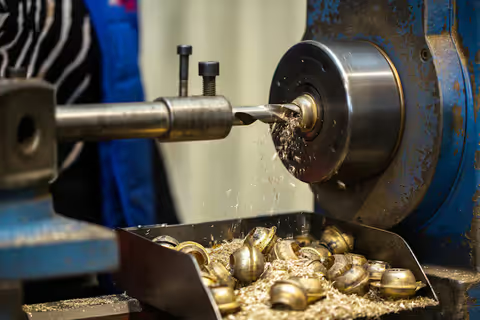
CNC machine suppliers are organizations that provide computer numerical control (CNC) machines used in precision manufacturing and automated production environments. These suppliers exist to support industries that require high accuracy, repeatability, and efficiency in machining operations such as cutting, milling, drilling, turning, and shaping materials.
CNC machines emerged to meet this demand, and CNC machine suppliers developed to design, assemble, distribute, and support these systems. Suppliers act as a bridge between machine manufacturers, technology developers, and industrial users by delivering equipment that aligns with specific production requirements.
Today, CNC machine suppliers play an essential role in modern manufacturing ecosystems by enabling access to precision machining technologies across diverse industries.
Importance: Why CNC Machine Suppliers Matter Today
CNC machine suppliers matter because manufacturing quality, productivity, and scalability depend heavily on the availability of reliable and advanced machining equipment.
Who relies on CNC machine supplier
- Manufacturing and production facilities
- Automotive and aerospace industries
- Metalworking and fabrication plants
- Electronics and precision component manufacturers
- Tooling and prototyping workshops
Key challenges CNC machine suppliers help address
- Demand for high-precision machining
- Need for repeatable and consistent production
- Integration of automation into manufacturing lines
- Adaptation to complex part geometries
- Support for diverse materials and tolerances
- Scalability of production capabilities
By providing access to advanced CNC systems, suppliers support industrial efficiency and technological advancement.
Recent Updates and Trends (2025–2026)
The CNC machine supplier landscape continues to evolve as manufacturing technology advances and global production demands shift.
Recent trends
- Smart CNC machines (2025): Increased integration of sensors and digital monitoring.
- Automation-ready systems (2025–2026): Greater compatibility with robotic loading and unloading.
- Advanced control software (2025): Improved user interfaces and machining precision.
- Multi-axis machining growth (2026): Expanded adoption of 5-axis and hybrid machines.
- Sustainability-focused designs (2026): Emphasis on energy efficiency and reduced material waste.
These trends reflect growing alignment between CNC machine suppliers and Industry 4.0 manufacturing principles.
Laws and Policies Affecting CNC Machine Suppliers
CNC machine suppliers operate within regulatory frameworks related to machinery safety, trade, and industrial standards.
Key regulatory considerations
- Machinery safety standards: Define design and operational safety requirements.
- Electrical and control system regulations: Apply to powered and automated equipment.
- Export and trade compliance rules: Govern international equipment distribution.
- Environmental regulations: Address emissions, energy use, and waste management.
- Industry-specific standards: Apply to aerospace, automotive, and medical manufacturing.
Compliance with these regulations ensures safe deployment and lawful distribution of CNC machines.
Tools and Resources Used with CNC Machine Suppliers
Effective collaboration with CNC machine suppliers involves technical tools and planning resources.
Technical and Evaluation Tools
- Machine specification and capability documents
- Simulation and machining software
- Performance benchmarking references
- Material compatibility charts
- Precision measurement standards
Operational and Planning Resources
- Installation and commissioning guidelines
- Operator training documentation
- Preventive maintenance frameworks
- Spare part and tooling references
- Quality assurance and inspection protocols
Table: Common Types of CNC Machines Provided by Suppliers
| CNC Machine Type | Primary Function |
|---|---|
| CNC Milling Machines | Multi-axis material removal |
| CNC Turning Machines | Precision rotational machining |
| CNC Machining Centers | Integrated milling and drilling |
| CNC Laser Cutting Machines | Non-contact material cutting |
| CNC Plasma Cutting Machines | High-speed metal cutting |
| CNC Grinding Machines | Surface and precision finishing |
Table: Key Factors Considered When Evaluating CNC Machine Suppliers
| Evaluation Factor | Description |
|---|---|
| Machine Accuracy | Precision and repeatability levels |
| Technology Compatibility | Control systems and software support |
| Application Range | Materials and part complexity |
| Automation Readiness | Integration with robotics and loaders |
| Support Infrastructure | Technical documentation and training |
| Compliance Standards | Alignment with safety and quality norms |
CNC Machine Supplier Engagement Workflow Overview
A typical engagement workflow with CNC machine suppliers includes:
- Production Requirement Analysis Machining needs and specifications are defined.
- Supplier Evaluation Capabilities and machine options are reviewed.
- Technical Assessment Machine performance and compatibility are assessed.
- Planning and Configuration Machine setup aligns with production workflows.
- Installation and Integration Equipment is deployed into the facility.
- Performance Monitoring Output quality and efficiency are evaluated.
This workflow supports structured and informed adoption of CNC machining technology.
FAQs
1. What do CNC machine suppliers provide?
They provide CNC machines used for automated and precision manufacturing.
2. Why are CNC machine suppliers important in manufacturing?
They enable access to advanced machining technology and automation.
3. Do CNC machine suppliers support different industries?
Yes. Their machines are used across automotive, aerospace, electronics, and more.
4. What types of CNC machines are commonly supplied?
Milling, turning, machining centers, cutting, and grinding machines.
5. Are CNC machine suppliers aligned with Industry 4.0 trends?
Yes. Many support smart manufacturing and digital integration.
Conclusion
CNC machine suppliers are vital contributors to modern manufacturing, providing the precision equipment and technological capabilities required for automated and high-quality production. By supplying advanced CNC machines, supporting diverse machining applications, and aligning with evolving automation trends, these suppliers help industries achieve consistency, scalability, and efficiency. Recent advancements in smart controls, multi-axis machining, and sustainability-focused designs have further strengthened their role in industrial ecosystems. Supported by regulatory standards, structured evaluation processes, and technical resources, CNC machine suppliers continue to shape the future of precision manufacturing and industrial automation.